
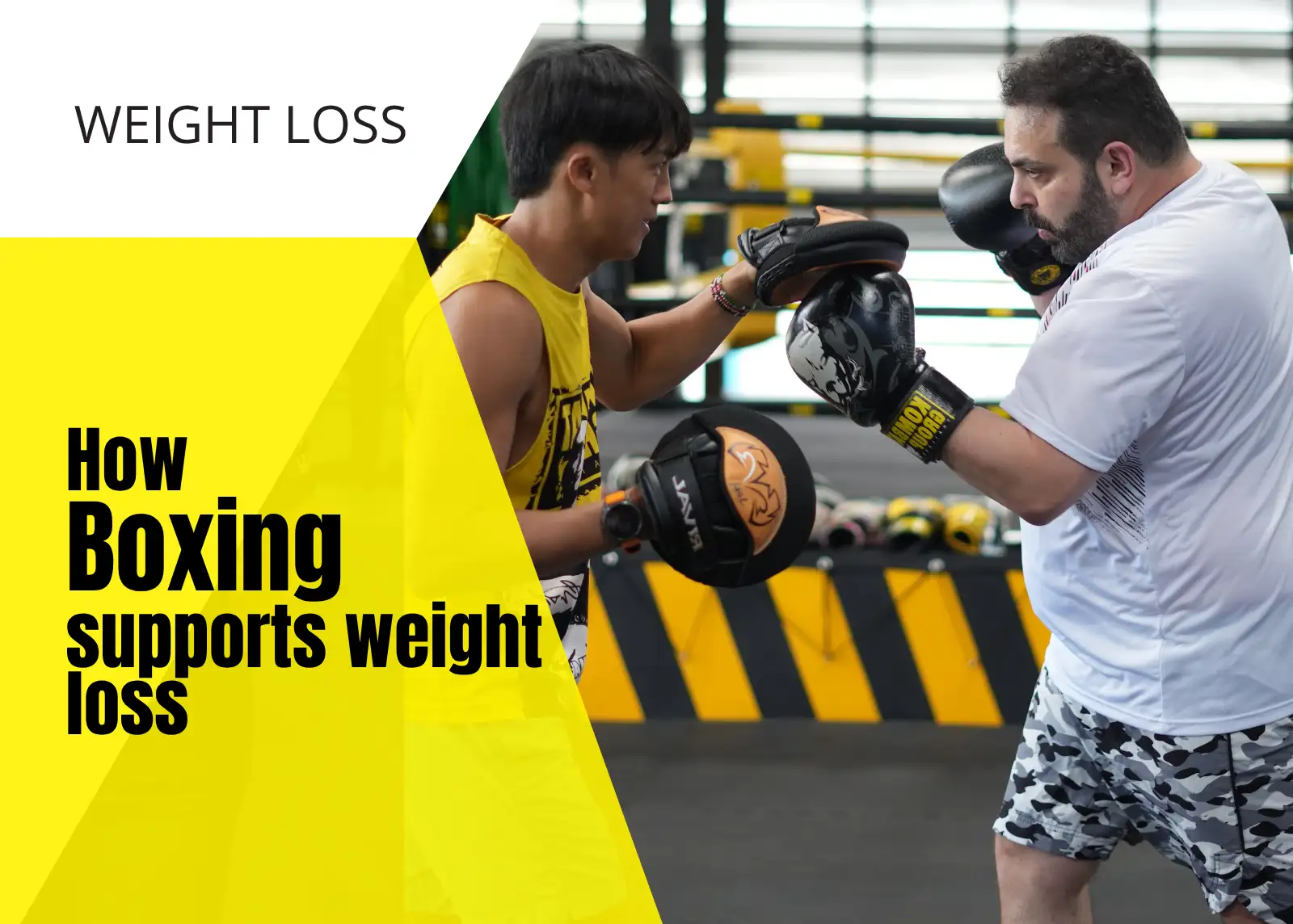
Yes, boxing can help with weight loss. It combines cardiovascular exercise, repeated whole-body movement and periods of relatively high intensity, which can increase energy expenditure and improve fitness.
But boxing is not a shortcut that automatically causes fat loss. Losing body fat still depends largely on maintaining an energy deficit over time (using more energy than you consume) while following habits you can sustain.
That is why the real benefit of boxing for weight loss is not a specific number of calories supposedly burned in one hour. It is the combination of physical activity, progressive fitness, consistency and an engaging form of exercise that many people actually enjoy enough to keep doing.
Key Takeaways
Boxing can support weight loss by increasing physical activity and energy expenditure. There is no universal number of calories burned per boxing session. Boxing can include HIIT-style intervals, but not every session is HIIT. Weight-loss results depend on training consistency, nutrition, recovery and overall energy balance. Complete beginners can start boxing progressively without sparring.
In this article
Why Is Boxing Good for Weight Loss?
Boxing is physically demanding because you are rarely using just one part of your body.
Effective punching starts from the floor. Your feet move, your legs create force, your hips and torso rotate, your core stabilises the movement and your shoulders and arms complete the punch. Add footwork, defensive movement, bag work, pad rounds and conditioning drills and a boxing session can become a substantial cardiovascular workout.
This can support weight loss in several ways.
First, physical activity increases your total daily energy expenditure. Boxing can therefore contribute to the calorie deficit required for weight loss.
Second, regular boxing can improve cardiovascular fitness and work capacity. As your conditioning improves, you may gradually be able to train for longer, complete more rounds and tolerate a greater overall volume of activity.
Third, boxing provides variety. You are learning combinations, practising technique, moving around the bag or working with a coach rather than simply repeating one movement for an hour. For some people, that makes exercise more enjoyable, and exercise that you can repeat consistently is generally more useful than a theoretically perfect workout you dislike.
How Many Calories Does Boxing Burn?
There is no single reliable number of calories that everyone burns during one hour of boxing.
Energy expenditure changes according to your body weight, fitness level, workout intensity, length of the rounds, rest periods and the type of boxing activity you are performing.¹
Technical shadowboxing, for example, is very different from sustained heavy-bag work or hard rounds on the pads. Sparring introduces another level of intensity again.
This is why claims that boxing burns exactly a certain amount of calories per hour are misleading when presented as if they apply to everyone.
Boxing can certainly be vigorous and energy-demanding. The more useful question for weight loss, however, is not “How many calories did this one workout burn?” but “Can I train consistently enough for this activity to become part of a sustainable lifestyle?”
Is Boxing a HIIT Workout?
Boxing can contain many of the characteristics of high-intensity interval training, but not every boxing session should automatically be described as HIIT.
Traditional boxing training often alternates periods of work and recovery. You may complete a hard round on the pads or heavy bag, recover briefly and then repeat. This interval structure can produce a vigorous cardiovascular challenge.
However, boxing training also includes technical drills, footwork, shadowboxing and skill development that may be performed at substantially lower intensities.
HIIT is therefore one tool within boxing training rather than the reason boxing “works” for everyone.
It is also inaccurate to describe HIIT as the universal gold standard for weight loss. Research comparing high-intensity interval training with moderate-intensity continuous exercise generally shows that both can improve body composition and fitness.² HIIT may be particularly time-efficient, but it is not consistently superior for every measure of weight or fat loss.
The most effective approach is usually the one that matches your fitness level, allows adequate recovery and is sustainable enough to repeat week after week.
What Does Research Say About Boxing and Weight Loss?
One frequently cited study provides some interesting evidence, but its findings need to be kept in perspective.
In a 2015 pilot study, researchers compared 12 weeks of boxing-based interval training with brisk walking in adults with abdominal obesity.³
Only 12 participants entered the study: six in the boxing group and six in the walking group. Participants were prescribed four exercise sessions per week.
The boxing group reduced its average body-fat percentage from 33.5% to 29.5%. The researchers reported this as a 13.2% relative reduction, and this change reached statistical significance.
The boxing group also showed average reductions in body weight, BMI and waist circumference. However, those individual weight-related changes did not reach statistical significance in this very small sample.
There are other important limitations. The walking group was not supervised in the same way as the boxing group, adherence differed between groups, and changes in diet and activity outside the training sessions were not monitored.
The researchers therefore described their findings as preliminary and called for larger, better-controlled trials.
So the study is encouraging evidence that structured boxing training may improve body composition and cardiovascular fitness. It is not proof that boxing guarantees a particular percentage of weight or fat loss.
How Often Should You Box for Weight Loss?
There is no ideal boxing frequency that applies to everyone.
For someone who has not exercised regularly, two or three boxing sessions per week can be a sensible starting point. This provides enough exposure to begin learning the movements and improving fitness without immediately turning every day into a hard training day.
As your conditioning improves, training volume can gradually increase according to your recovery, goals and overall activity level.
Current physical-activity guidelines for adults recommend at least 150 minutes of moderate-intensity aerobic activity per week, or 75 minutes of vigorous activity, or an equivalent combination. Adults are also encouraged to perform muscle-strengthening activity on at least two days per week.⁴
That does not mean every boxing session needs to be exhausting.
Technical sessions, lighter bag work, walking, strength work and harder boxing rounds can all contribute to an effective weekly program. For weight management, the overall routine matters more than trying to make every workout as intense as possible.
If you’re considering a residential training camp, you can also check our training schedule to see how boxing can fit alongside other fitness and recovery activities.
Can Complete Beginners Use Boxing for Weight Loss?
Absolutely.
You do not need to be fit before learning boxing, and you do not need to start with sparring.
A beginner can initially focus on stance, guard, basic punches, footwork and simple combinations. Intensity can then increase as technique and conditioning improve.
This matters particularly when someone is starting boxing while significantly overweight or after a long period without regular exercise. Trying to copy an experienced boxer’s pace from the first session usually provides little benefit.
Progressive training is much more useful.
At Kombat Group, for example, many people who choose Western Boxing are beginners or intermediate students training primarily for fitness, skill and confidence rather than competition. Sparring is optional.
For a beginner using boxing as part of a weight-loss journey, the first objective should be to build the ability to train consistently, not to prove how exhausted you can become in one session.

Do You Need to Change Your Diet if You Box?
Usually, yes, if weight loss is the objective.
Exercise increases the amount of energy you use, but it is surprisingly easy to compensate for a hard workout by eating or drinking more calories afterwards.
Long-term fat loss therefore works best when regular physical activity is combined with an eating pattern that creates an appropriate calorie deficit while still providing enough nutrition to support training.⁵
That does not mean starving yourself or eliminating entire food groups.
A sustainable diet should provide adequate protein, fruits and vegetables, appropriate carbohydrate sources, healthy fats and enough overall food to recover from your workouts.
This becomes particularly important as boxing volume increases. Training hard while drastically under-eating may leave you exhausted, reduce training quality and make the overall plan much harder to maintain.
The objective is not to eat as little as possible. It is to create a nutrition strategy that supports both fat loss and your ability to train.
Recovery Matters More Than Many Beginners Expect
More training is not automatically better.
Boxing places repeated demands on your legs, shoulders, core and cardiovascular system. Your body needs time to adapt.
For beginners especially, recovery should be treated as part of the training plan rather than as time wasted between workouts.
Sleep, hydration, appropriate nutrition and easier training days all help you return to the next session ready to train properly.
This is also one reason a gradual increase in training volume usually works better than suddenly attempting hard boxing sessions every day.
Weight loss requires consistency over weeks and months. A routine that leaves you constantly exhausted or injured is unlikely to remain consistent.
What Results Can You Expect From Boxing?
There is no responsible way to predict exactly how much weight someone will lose from boxing.
Results depend on your starting weight and body composition, food intake, training volume, daily activity, sleep, recovery, age, health and individual physiology.
And the scale does not tell the whole story.
Someone beginning regular boxing may notice improvements in fitness, waist measurement, mobility, coordination and body composition even when body weight is changing more slowly.
For that reason, useful progress measures can include body weight, waist circumference, body composition, fitness improvements and how well you are able to perform your training sessions.
The goal should be measurable progress, not chasing somebody else’s transformation.
Boxing Works Best as Part of a Complete Weight-Loss Strategy
Boxing can be a very effective component of a weight-loss program because it provides cardiovascular work, skill development, progressive training and an engaging reason to stay active.
But the strongest approach goes beyond boxing alone.
Training needs to be supported by appropriate nutrition, recovery and enough consistency for the changes to accumulate over time. Strength and functional training can complement boxing, while monitoring body composition and performance can help show whether the overall strategy is working.
This is also where a structured weight-loss program can be useful. Instead of treating exercise, food and recovery as separate problems, they can be organised around the same objective.
The key is not finding the workout that promises the largest calorie burn, rather it’s creating a system you can actually follow long enough to produce results.
Frequently Asked Questions
The Bottom Line
Boxing helps with weight loss by increasing physical activity and energy expenditure, improving cardiovascular fitness and providing a demanding form of exercise that can become progressively more challenging as your fitness improves.
It is not a magic fat-loss workout, and there is no universal number of calories that one boxing session burns.
The biggest results come from the combination of boxing, consistent activity, appropriate nutrition and adequate recovery.
Want to experience structured boxing, fitness, nutrition and progress tracking together? Explore our Weight Loss Camp in Thailand.
Contact Us by filling out the form below:
Sources & Evidence
- 2024 Adult Compendium of Physical Activities.
- Sanca-Valeriano S et al. [full study title], 2023.
- Cheema BS et al. Effect of an office worksite-based boxing training intervention on physical fitness and health-related quality of life in office workers. BMC Sports Science, Medicine and Rehabilitation, 2015.
- CDC. Physical Activity and Your Weight and Health.
- NIDDK. Eating & Physical Activity to Lose or Maintain Weight.


